
Core Concept #2: Parallel Processing (why they’re fast)...

ChatGPT and Me

Parallel processing and the ability to do it at very large scale seems to be one of the lynchpins of AI. I ask GPT for a bit more info on why GPUs are so important in that process and get a quick class on GPUs, TPUs, and other forms of acceleration.

My input (prompts) are in the boxed elements. The rest is ChatGPT's output. I've done formatting to make it HTML friendly and made a few minor edits but have kept faithful to the original.

Parallel processing and the advent of modern GPUs is one of the reasons that large models like GPT became practical. Why are GPUs so important to AI and is it only in the training or also during general use?
GPUs are useful for AI for the same reason forklifts are useful in a warehouse. A CPU is a very smart office manager. A GPU is ten thousand interns all lifting boxes at once. Humanity looked at video game hardware and accidentally built the engine of the AI era. Typical species behavior.

A CPU has a small number of very powerful cores optimized for sequential tasks:
A GPU has thousands of simpler cores optimized for doing the same mathematical operation on huge amounts of data simultaneously. AI training is mostly giant matrix multiplication. Endless oceans of numbers smashing into other oceans of numbers. Neural networks are basically: That workload is perfect for GPUs. For example, when GPT processes text, words become vectors. Then the model repeatedly computes relationships between gigantic arrays of numbers. GPUs can do many of these calculations in parallel. That difference becomes enormous at scale.

Training absolutely depends on GPUs (or similar accelerators like TPUs). Training GPT-class models on CPUs alone would take absurdly long and consume ridiculous power. You’d basically be waiting geological epochs for results. The loading bar would outlive civilizations.

But GPUs are also heavily used during inference, meaning the actual execution when you chat with GPT. When you type: “Why are cats weird?” the model still performs huge matrix operations to predict the next token. That process is smaller than training, but still computationally intense. So:


The difference is scale.

Training:
Inference:
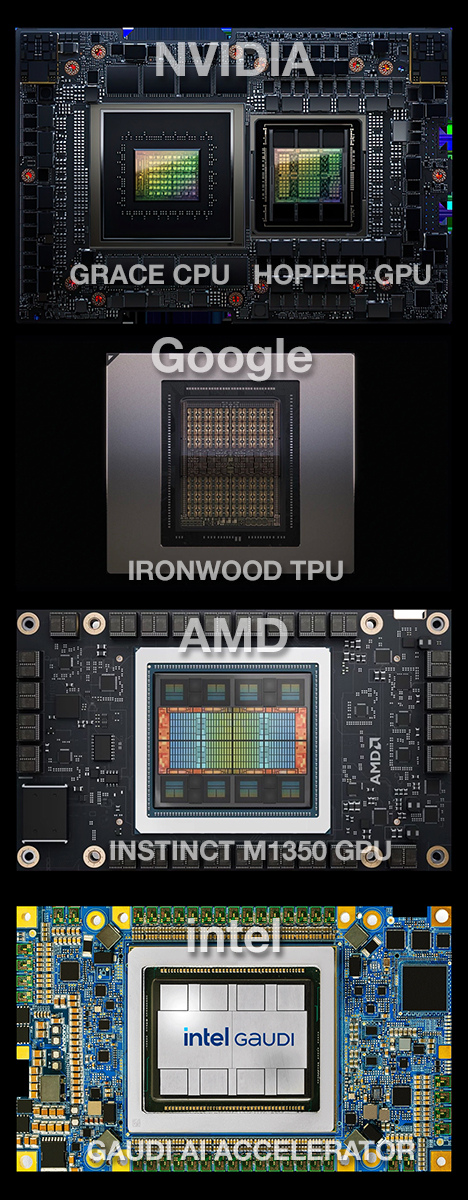
GPU, TPU, and AI accelerator chips

Both benefit from GPUs because both involve large parallel math workloads. But during inference, CPUs still matter. They often handle orchestration, networking, memory management, batching requests, and system coordination. Meanwhile GPUs do the heavy tensor math.

There are also specialized AI chips now:

Because once humans realized “graphics cards can predict language,” the semiconductor industry collectively entered a caffeine-fueled arms race worth hundreds of billions of dollars.

One more subtle point:

Parallelism is especially valuable for transformers, the architecture behind OpenAI GPT systems. Transformers process many relationships in parallel using attention mechanisms. Earlier AI architectures like RNNs were more sequential, which limited scaling. That’s one reason transformers exploded in capability: they matched GPU hardware incredibly well.

So the short answer is: GPUs are better than CPUs for AI because AI is dominated by massively parallel math operations. They are crucial both for training and for running GPT during normal use. Training benefits more dramatically, but inference also relies heavily on GPU acceleration at modern scales.

The semiconductor industry apparently decided that three names for “very fast matrix math hardware” was the minimum viable confusion:

GPUs are general-purpose compute engines adapted for AI, TPUs are Google’s specialized AI processors, and AI accelerators are the umbrella category covering all specialized AI chips, including TPUs and many custom designs.

A handy rule of thumb:

Give me a short course on GPUs, TPUs , and AI accelerators. What are the key differences?

Most AI workloads boil down to performing huge numbers of simple mathematical operations on very large arrays of numbers (called tensors). The winner is not the chip with the smartest individual core. It’s the chip that can perform the most multiply-and-add operations while moving data around efficiently.

The three big design philosophies are:
GPUs: the general-purpose workhorse

The modern AI revolution was built primarily on GPUs. A GPU contains thousands of relatively simple processing units that execute many operations simultaneously. Originally this was for graphics rendering, where millions of pixels had to be processed in parallel. Researchers realized neural networks have the same basic property.

Strengths
Weaknesses
TPUs: Google’s AI-only machines

A TPU (Tensor Processing Unit) is Google’s custom chip designed specifically for neural network operations. Instead of trying to be flexible, TPUs are optimized for one thing: Matrix multiplication at absurd scale. The key innovation is something called a systolic array, where data flows rhythmically through a grid of compute units, minimizing memory movement.

Strengths
Weaknesses
AI accelerators: Gaudi and friends

After NVIDIA became the dominant AI hardware company, everyone else collectively experienced the same thought: “Perhaps giving one company all the money forever is not ideal.” This produced a wave of specialized AI accelerators.

Intel’s Gaudi chips were designed specifically for training large AI models. Their big design choice was unusual:
Advantages
Disadvantages
Other notable accelerators:
Advantages
Each tries to solve a different bottleneck:
The reason NVIDIA dominates today is not merely that its chips are fast. It’s that they spent roughly fifteen years building the software ecosystem while everyone else was still assuming GPUs were mostly for making dragons in video games look more realistic.

The architectural differences
Feature  GPU  TPU    Gaudi/AI Accelerator
 Purpose  General parallel computing  A-specific   AI-specific
 Flexibility  Very high  Moderate  Moderate
Software Ecosystem   Excellent  Good  Developing
Efficiency   High  Very high  Very high
Networking   Proprietary high speed  Custom fabric  Often Ethernet
Best Use   General AI workloads  Massive AI training  Specalized AI deployment

Green Hosting Badge