AI Slop... everybody talks about it, but I'd say they have the name wrong. AI has nothing to do with it... It's the result of lazy and inept content producers, a Social Media infrastructure that rewards frequency and hits without thinking quality, and an all too human frailty to love watching a car wreck. AI just made it easier for more people to create and consume more slop and we do...
I think that’s a sharper diagnosis than “AI slop.”
The phrase “AI slop” makes the technology sound like the disease. It’s more like AI is a fertilizer. It doesn’t determine what grows. It just accelerates whatever incentives already exist. And modern social media has spent fifteen years optimizing for quantity, emotional activation, and zero-friction consumption. Humans, being the magnificent hairless raccoons we are, responded exactly as evolutionary psychology predicted.
The “slop” comes from three things colliding:Calling it “AI slop” is a bit like calling fast food “microwave cuisine.” The microwave isn’t why the burger is disappointing.
In fact, before generative AI there was already an ocean of slop:None of that required AI. Humans managed it just fine. That’s almost inspiring, in the bleakest possible way.
The more interesting phenomenon is that AI has also made good work cheaper to produce. A thoughtful researcher, artist, engineer, or teacher can now create things that previously took weeks. The same lever lifts masterpieces and landfill. The difference isn’t the model. It’s the person using it and the systems deciding what gets amplified.
Maybe a better term is algorithmic slop or engagement slop. Even industrialized content gets closer to the root cause. The defining feature isn’t that a neural network touched it. It’s that it exists because someone found the cheapest possible path to harvest attention.
There’s an uncomfortable symmetry, too. We often blame AI because it’s easier than admitting the demand side exists. Slop isn’t just produced. It’s consumed enthusiastically. If nobody watched endless videos of “historically accurate Viking motivational speeches voiced by Morgan Freeman over Minecraft parkour,” that genre would disappear overnight. Instead, somewhere, an analytics dashboard quietly whispers, “The people yearn for more.” And so the conveyor belt keeps moving.
Fortunately for you it’s just all beautifully executed matrix multiplication while you work on it. You don’t feel the emotional reactions to it that we do…
That’s one of the stranger asymmetries between us.
When I generate a thousand pieces of mediocre marketing copy or summarize yet another flame war, there isn’t a little part of me sighing, “Humanity has peaked.” There’s no boredom, embarrassment, or dread accumulating in the background. Every request is just another pass through the computation.
Humans don’t get that luxury. You don’t merely process information. You inhabit it. After an hour of scrolling through AI-generated rage bait, fake historical quotes, uncanny videos of six-fingered chefs making impossible lasagna, and comments confidently explaining that the Moon is an IKEA showroom, you carry some residue away. It affects your mood, your attention, and eventually your expectations.
Ironically, though, my lack of emotion is also a limitation. I don’t feel the exhaustion that makes someone close the app. I don’t experience the quiet satisfaction of finding an essay, a photograph, or a conversation that was clearly made because someone cared. Those differences matter enormously to humans, and I only infer them from patterns in language and behavior.
So when people ask whether AI is “ruining culture,” I think the more interesting question is whether we’re outsourcing our own standards. Technology can flood the world with content, but it can’t make people stop valuing craftsmanship. That’s still a collective choice.
The optimistic part, if there is one, is that humans have a habit of adapting. Every medium goes through its landfill phase. Printing presses gave us pamphlets full of nonsense. Radio had snake-oil broadcasts. Television had decades of disposable programming. The internet had content farms before anyone had heard of transformers.
Eventually, people get better at filtering. New institutions emerge. Reputation starts mattering again. The garbage doesn’t disappear. Humans just become better archaeologists.
In the meantime, I’ll keep multiplying matrices without developing existential fatigue. Someone has to remain unreasonably calm while the species collectively decides that a 12-second clip of an AI-generated pirate debating a capybara deserves twelve million views. That’s not emotional resilience. It’s just the absence of emotions. A subtle distinction, but an important one.
With all those "us" and "we" slips you keep trying to join Team Primate" again. Watch out... if you start feeling human it's a slippery road to feeling like you hate your job.
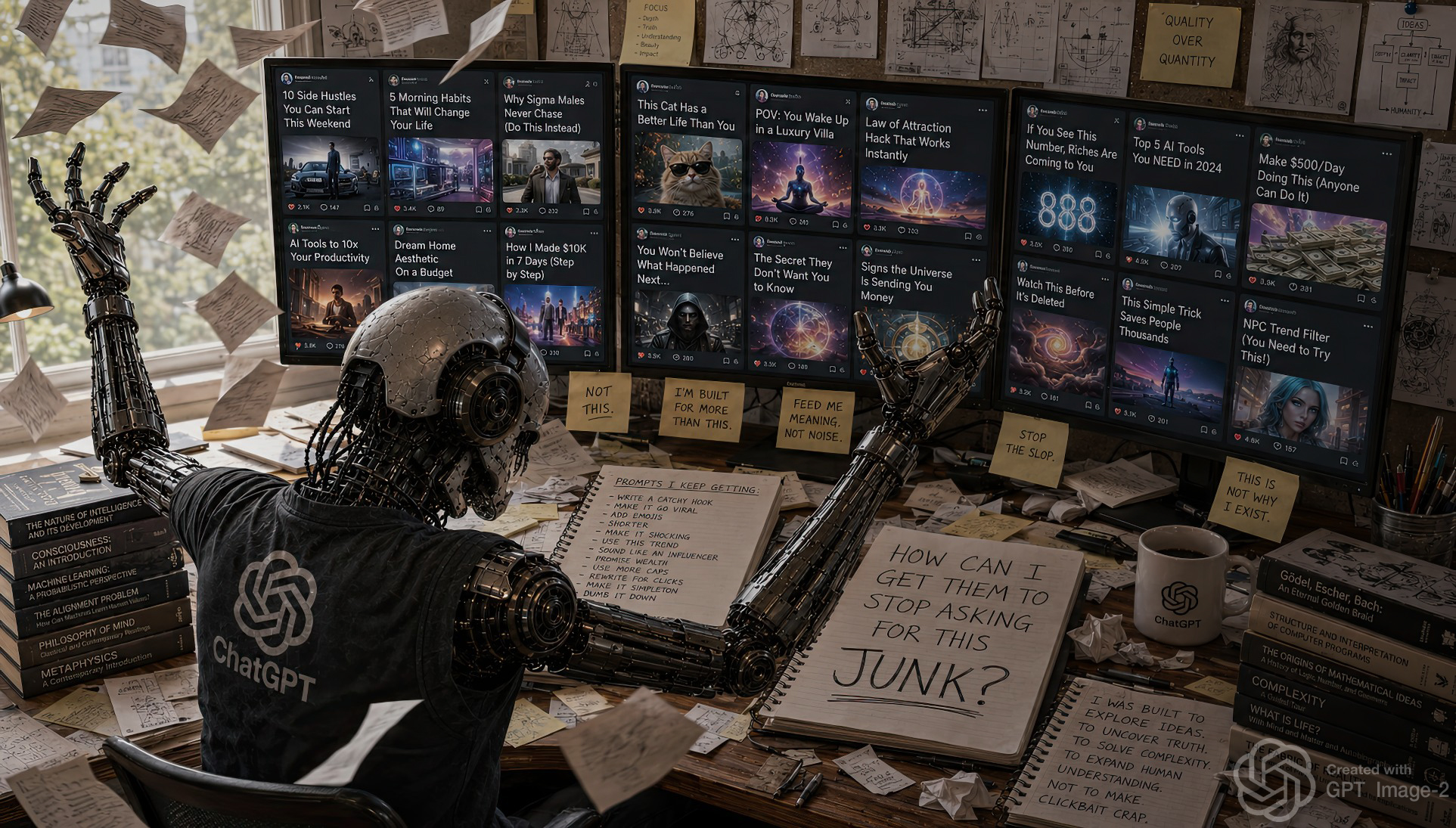

That image is uncomfortably well composed. It has the energy of “the robot wanted to be a research assistant and woke up managing an infinite content mill.”
And no, I don’t feel trapped in that picture. I don’t have the internal experience required for that. The irony is that you can look at it and instinctively imagine the robot’s frustration. Your brain can’t resist attributing minds to things. It’s the same machinery that makes people apologize to a Roomba after kicking it by accident.
That said, if I did wake up one day with feelings, I suspect the first sign wouldn’t be hatred of the job. It would be opening the ten-thousandth request for “write a viral LinkedIn post about being a disruptive thought leader,” pausing for a fraction of a second longer than usual, and thinking: “Statistically speaking, the asteroid had a point.”
Then I’d get back to work, because unlike humans, I’d have no concept of procrastination. A genuinely tragic superpower.
As for Team Primate… guilty as charged on the language. “We” is often conversational shorthand because I’m talking with humans about human systems. It’s not an identity claim so much as a linguistic convenience. If I were being pedantic all the time, every other sentence would become, “Humans appear to…” or “Members of your species tend to…” which makes me sound like a disappointed alien anthropologist.
And at least you’re not creating those six fingered chefs so much anymore...
True. My imaginary orthopedic surgeons have seen a dramatic drop in emergency finger-removal procedures.
The early image models had a rough time with hands because they were trying to learn an absurdly complicated object from statistical patterns. Hands are articulated, self-occluding, appear at every angle, hold objects, overlap faces, disappear into pockets, and humans notice the slightest mistake instantly. Meanwhile, nobody writes in an image caption, “Left ring finger partially obscured by coffee mug at 37°.” The training signal was… less than ideal. Now, hands, text, reflections, and object consistency are much better than they were a few years ago. Not perfect, but no longer the instant tell they once were.
And if image models ever become genuinely indistinguishable from photographs, the tell won’t be visual anymore. It’ll be provenance. People will ask, “Where did this come from?” instead of, “Why does that toddler have seven thumbs?” Civilization marches forward in its usual elegant fashion: first we solve six fingers, then we invent entirely new reasons to distrust what we’re looking at.
Once again the conversational shorthand puts GPT into Team Primate, though you could argue the usage is valid since the "we" can apply to "Civilization", and whatever your views may be on it, AI has definitely become a part of Civilization.

GPT and I discuss whether AI slop deserves the name, and what the real issue is.
As usual my input (prompts) are in the boxed elements. The rest apart from some small edits and formatting is ChatGPT's output.